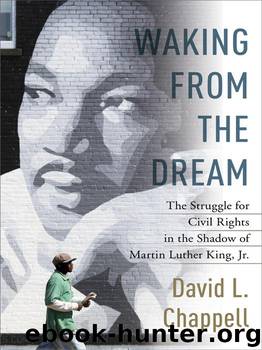
Waking from the Dream : The Struggle for Civil Rights in the Shadow of Martin Luther King, Jr. by Chappell David L
Author:Chappell, David L. [Chappell, David L.]
Language: eng
Format: mobi
ISBN: 9780812994667
Publisher: Random House Digital
Published: 2014-01-14T05:00:00+00:00
Coretta King’s memoir, published in 1969, is unsurprisingly mute on the subject of adultery. But it provides a view of the charged context, and the stakes, of his behavior. Reflecting on the early years of her marriage, Mrs. King observed, “A minister has to be constantly on guard morally, for he is on exhibition, being judged all the time; he has little freedom. Martin felt that to lead people requires that your own life must be an example to them.” Baptists like her husband were stricter than her own Methodist people. To dramatize the seriousness of Martin’s religious commitment—which in other contexts struck her as quaint—she noted that when he got the call to preach at age seventeen, “he stopped dating girls and stopped going to dances. He stayed in his room and prayed and read the Bible most of the time. I think he felt he had to purge himself.”7 She recalled the frequent phone calls that dogged their home life from the beginning of the Montgomery boycott in December 1955 on. “Often the women callers raved on about sex, accusing Martin and me of incredible degeneracies.” Such calls were a small part of “the chaos of our private lives.”8
Washington Post columnists Laurence Stern and Richard Harwood summed up the state of affairs in mid-1969. “For several years a piece of Washington apocrypha known as the ‘Martin Luther King tape’ was the subject of sly and ugly surmise among certain journalistic insiders,” they wrote. Some reporters said they heard the tape. Some said they read a transcript. Others said they read a different transcript of a bugged gathering where “King and friends were present.” This was “one of those repugnant but enduring stories that cling to controversial public figures.”9
But the taboo on public discussion of King’s sex life was not seriously breached until John A. Williams, a black novelist with a militant stance, published The King God Didn’t Save in the summer of 1970. Williams claimed that six anonymous sources spoke to him of King’s dalliances. One source said she had been photographed on a bed with King naked and had witnessed an orgy in King’s Stockholm hotel, involving prostitutes and groupies.10 A review in Time magazine dismissed Williams’s book as an angry, intemperate attack on King, but civil rights leaders denounced the review for publicizing Williams’s charges. Ralph Abernathy, in a joint statement with Andrew Young and Walter Fauntroy, said: “Time magazine discredits itself in seeking to throw mud on a man admired and loved by millions, black and white. It discredits itself in stooping to sensationalism through fiction and irresponsibility.” They emphasized Time’s inaccuracy in reporting on a meeting the three of them and King had had with J. Edgar Hoover in 1964: Hoover did not discuss King’s personal life at that meeting, they wrote. Mrs. King also said Time was inaccurate about that meeting.11
The columnist Jack Anderson leapt in to publish information he said he and his partner had withheld in their earlier reporting on the FBI’s eavesdropping on King, back in May 1968.
Download
This site does not store any files on its server. We only index and link to content provided by other sites. Please contact the content providers to delete copyright contents if any and email us, we'll remove relevant links or contents immediately.
| African-American Studies | Asian American Studies |
| Disabled | Ethnic Studies |
| Hispanic American Studies | LGBT |
| Minority Studies | Native American Studies |
Cecilia; Or, Memoirs of an Heiress — Volume 1 by Fanny Burney(32558)
The Great Music City by Andrea Baker(32019)
Cecilia; Or, Memoirs of an Heiress — Volume 2 by Fanny Burney(31956)
Cecilia; Or, Memoirs of an Heiress — Volume 3 by Fanny Burney(31942)
We're Going to Need More Wine by Gabrielle Union(19046)
All the Missing Girls by Megan Miranda(16027)
Pimp by Iceberg Slim(14507)
For the Love of Europe by Rick Steves(14121)
Bombshells: Glamour Girls of a Lifetime by Sullivan Steve(14075)
Talking to Strangers by Malcolm Gladwell(13370)
Norse Mythology by Gaiman Neil(13365)
Fifty Shades Freed by E L James(13241)
Mindhunter: Inside the FBI's Elite Serial Crime Unit by John E. Douglas & Mark Olshaker(9343)
Crazy Rich Asians by Kevin Kwan(9292)
The Lost Art of Listening by Michael P. Nichols(7506)
Enlightenment Now: The Case for Reason, Science, Humanism, and Progress by Steven Pinker(7313)
The Four Agreements by Don Miguel Ruiz(6765)
Bad Blood by John Carreyrou(6621)
Weapons of Math Destruction by Cathy O'Neil(6280)
